2025 Spring Garden Planning & Planting
I know this isn’t true for a lot of areas, but right now in Southern California it is getting warm (although this year I’m not sure it ever really got cold) and it’s time to start planning my summer garden, and planting my 2025 spring garden.
This post may contain affiliate links.
Last year I went all in and tried a lot of things that I hadn’t tried before. I wanted to learn more about new plants, and the best way to do that is to just plant them and try.
And I certainly did learn a lot.
Not because of the plants that I choose to grow, but because of the problems that I encountered. Squirrels and rabbits to be exact. And the snails didn’t help much either. They made sure to “take care” of my zucchini (which I’ve never had issues with before), while the squirrels ate everything else. The rabbits liked to munch, but they did far less damage than the squirrels.
To top it off, so many of my seeds either didn’t sprout, or died off before I even had the chance to replant them.
Honestly, the whole thing deflated me and just wore me out. It was awful to work so hard for months and barely get anything in return.
Because of that, this year I’ve decided to be more intentional about the crops I plant, and really focus on a few that I can give more attention too.
Winter/Spring
- Beans
- Peas
- Potatoes
- Lettuces/Spinach/Kale
- Ginger
- Turmeric
- Maybe: Garlic & Onions
Summer
- Tomatoes
- Bell Peppers
- Cucumbers
- Zucchini
- Spaghetti Squash
- Carrots
- Radishes
Companion Plants
- Marigold
- Nasturtium
- Basil
- Dill
- Oregano
- Chives
- Parsley
- Cilantro
- Rosemary
I would say that companion planting is my experiment for the year; along with some of the concepts from Square Foot Gardening. Because I grow in totes, I’ve always been careful to not over plant in them. But using the Square Foot Gardening idea, I want to push the limits and see if I can successfully grow more food in smaller spaces.
Fruit
We have some fruit trees already. Sadly the crazy winds that we got a few weeks ago ripped out a couple of them, and stripped the leaves off of the rest (the one’s that don’t lose their leaves in the winter at least).
We lost a loquat tree and pear tree. I’m hoping the others recover, but we’ll have to wait and see what regrows over the next month or so.
I also have a blueberry bush in a container that has been struggling. One of the first things I did when prepping the garden was to prep some soil (because blueberries need acidic soil) to repot it into a larger container. I’m hoping that the larger container and the increased acidity will help it to grow back stronger this year.
I’m also hoping to add some more berry plants this year. I’d love to have blackberries (we have some growing wild with thorns, I’d love some thornless ones), raspberries, and strawberries (which we’ve had before, but it seems like the last of them might not have made it through the dry winter.
*Update: I found some blueberry, raspberry, and blackberry bushes at Aldi. The quality is questionable, but the price just couldn’t be beat (about $6 each at my store) and so it was worth giving them a try. I’ll keep you updated. Also, there were a few traces of strawberries that did survive the winter. I think they’ll be just fine.
First Day in the Garden
This week I spent my first day working in the garden (not including when I went out to clean up the damage from the January winds). So what did I do?
First I prepped some soil to repot my blueberry bush. I mixed compost that we got from our city last year with peat moss, which over time should create acidic soil. I also heard that you can occasionally directly water blueberry plants with diluted vinegar water (I used 1/2 cup white vinegar to 1 gallon of water) to increase the acidity immediately. This is a short term, but quick acting, solution to a high pH soil. So I made the vinegar water and after watering the blueberry bush (still in its original container), I poured about 1 cup of the mixture into the soil. I will do this again when I repot it, and keep checking the pH of the soil to make sure that I’m not going overboard.
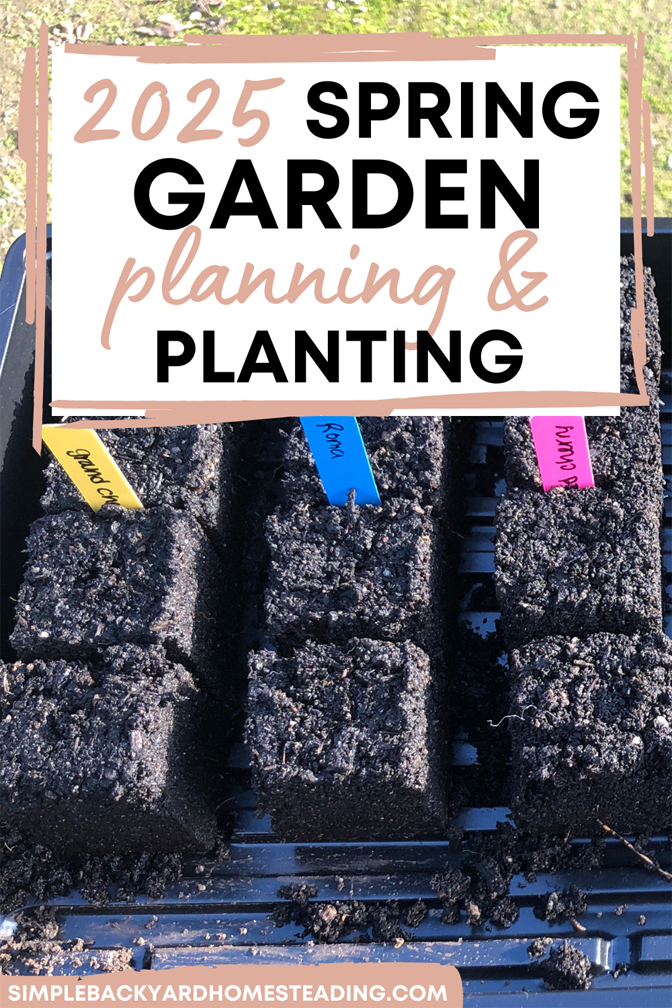
Next I created some soil blocks and started tomato and pepper seeds. I have 20 blocks total, 4 of each kind of plant.
- Cherry Tomatoes – my parents favorite for snacking
- Ground Cherry Tomatoes – my favorite for snacking. These taste like grapes.
- Roma Tomatoes – a good option for making sauces, which is what I plan to do with most of them.
- Green Bell Peppers
- Red Bell Peppers
I’ve heard that different colors of bell peppers are the same plant, but they just change color the longer they stay on the plant. In my experience, that is true. So I was intrigued that they sell RED bell peppers and wanted to try both to see if there’s a difference.
And finally, directly into my totes (my chosen containers for raised planters), I planted beans and peas. I did this in many of my existing totes, and will probably add more too. Beans and peas can help repair soil and add nitrogen back into it. So I’m partially doing it to repair the soil, but also because beans and peas are just a great thing to grow. We loved snacking on them last year, and they preserve well.
Going along with what I said about Square Foot Gardening, I planted 12 seeds into each tote. I believe it normally is 9 per square foot, but since the totes are large than a square foot, I added another row of 3 to each tote.
I am curious to see how they turn out.
Is this really simple gardening?
Well, yes and no.
I am adding in some wildcards; things that I either haven’t grown before or that I haven’t grown successfully. Which would include pretty much everything in the “Companion Plants” list except basil, ginger, turmeric, and carrots. And some I haven’t been able to grow from seed very well (which is what I’m doing this year), but I’ve had a lot of success growing them from starter plants purchased from Home Depot/Lowes.
But overall, most of these are things that I grow every year. Most of what I’m planting this year are things I’m familiar with in some capacity. Compared to last year, this looks a whole lot more simple to me. I even decided to skip some of the things I had success with last year, just for the sake of keeping it easier. I won’t be planting pumpkins, watermelon, corn, or the extensive variety of squashes that I attempted last year.
Except for the watermelon (which the squirrels completely devoured at about 4 inches tall- even under protective covering), I was able to harvest some of each of them. In fact, I think we had more successful pumpkins than anything else the whole season. Oh, except maybe beans and peas. Those did pretty well too.
I almost wasn’t going to plant a garden at all this year. But I’m kind of addicted to it. I love watching them grow, and I love when I get to harvest something that started out so small. Plus, I just feel that there is a lot of importance on being able to grow your own food. Especially now with groceries being so expensive. The more self-sufficient we can be, the better.
And if this is your first year growing food, it’s okay to start small. I know you’re probably watching all the gardening videos where people have filled their yards with gardens that seem to always be in season. I watch them too. Its easy to get caught up in how ideal that would be. But realistically, you need to start small. My first year was 4 tomato plants and a couple bell pepper plants (one of which didn’t make it after it got hit with the weed eater…).
Pick a few of your favorites. Something that you will want to eat. Every year (or season) you can gradually more. You will learn what you like and don’t like to grow. Maybe some years you just won’t be in the mood to grow something (which is what’s happening to me this year). And you will face new problems that need to be solved to keep your plants alive. Seriously. I don’t know why we never have the same problem as a previous year that I already know how to handle. It always has to be something new. Which I guess is good for learning, but those squirrels almost did me in last year.
Side note: I’ve done a garden in my back yard for years with squirrels and rabbits. I’ve never had them even remotely interested in eating my crops until last year.
Final Thoughts: A Fresh Start in the Garden
After last year’s struggles, I’m excited for a fresh start. By planting fewer varieties of crops and adding companion plants for pest control, I’m hoping for a more successful, stress-free growing season.
If you’ve had challenges in your garden, you’re not alone! Every year is a learning experience, and that’s part of the fun.
Are you planting a spring or summer garden this year? Let me know in the comments—I’d love to hear what you’re growing! 🌱